
Services
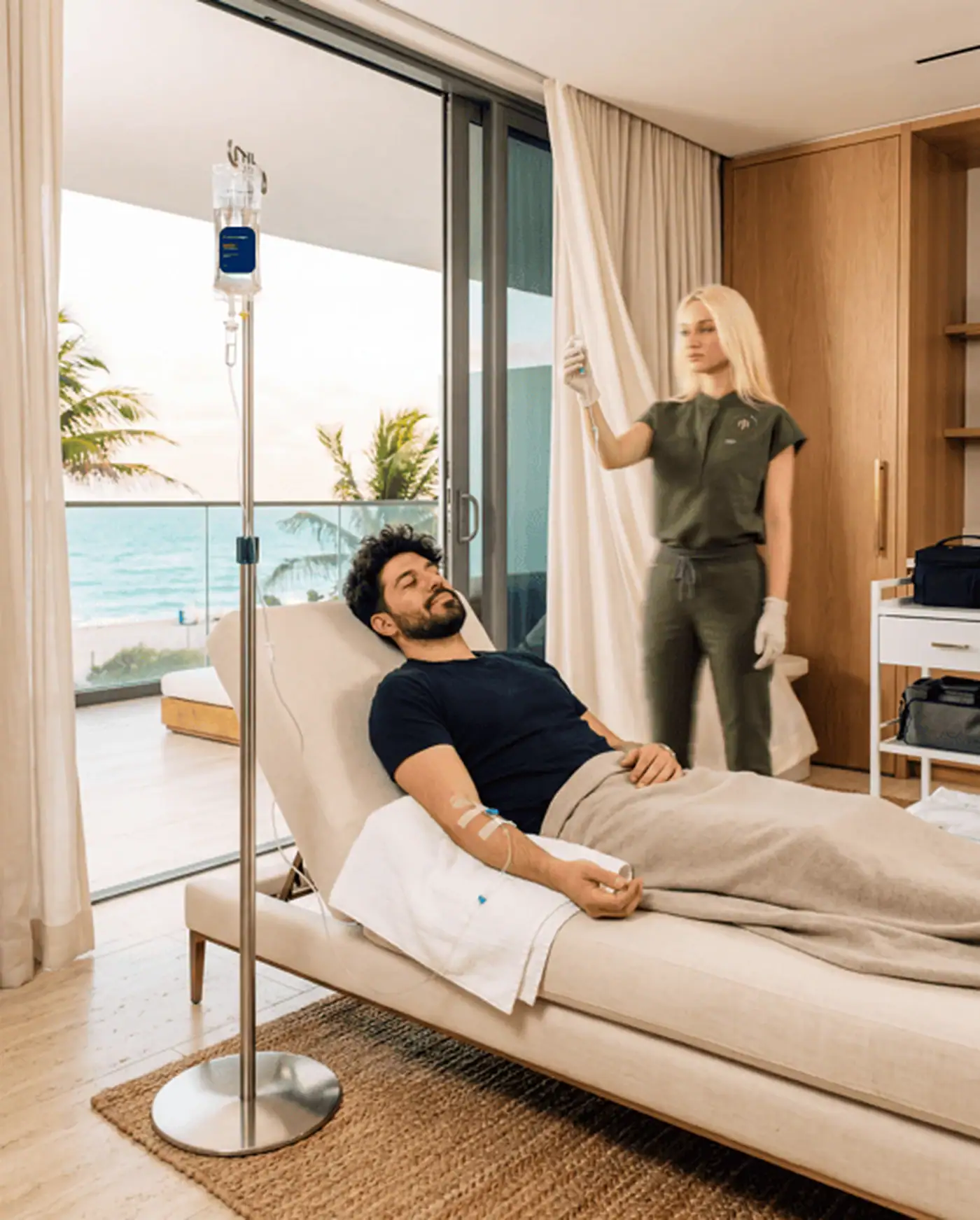
NAD+ Injections,
Explained
A plain guide to how NAD+ injections work, how a subcutaneous shot differs from the full IV drip, and how a physician decides which one belongs in your plan.
Educational guide. Physician-supervised therapy. In-clinic in Surfside or mobile across South Florida.
 Joint Commission Accredited
The only one in Florida
What are NAD+ injections?
NAD+ injections deliver nicotinamide adenine dinucleotide, a coenzyme found in every living cell, directly into the body. Bypassing the gut means far higher absorption than an oral supplement. There are three routes: a subcutaneous (SubQ) injection under the skin, an intramuscular (IM) injection into muscle, and an intravenous (IV) infusion into the bloodstream.
At TrufaMED the IV drip is the primary therapeutic route, because it reaches full bioavailability in a single session. Physician-prescribed SubQ injections are available for ongoing maintenance between IV loading sessions. This page explains the difference so you can have an informed conversation with your physician. For the drip itself, see NAD+ IV therapy in Miami; for at-home delivery, see mobile IV therapy.
How a NAD+ injection differs from the IV drip
The simplest way to picture it: the IV drip fills the tank, and the injection tops it off. One is a loading dose, the other is maintenance. Most supervised plans use both.
The NAD+ IV drip
A high-concentration infusion of about 500 mg delivered into a vein over 2 to 4 hours. It saturates your tissues in one sitting at full bioavailability, the ceiling no oral supplement can reach. This is the loading dose: best for getting started, acute recovery, and performance peaks. It needs a clinic visit or a mobile physician visit.
The SubQ injection
A small dose of roughly 25 to 100 mg placed in the fatty tissue just under the skin with a fine needle. It releases slowly and holds your level steady between infusions. This is maintenance: convenient, self-administered at home after training, and lower cost per dose. It is prescribed only after your first IV session and consultation.
Three ways to receive NAD+
The route decides how fast NAD+ reaches your bloodstream, how much of the dose your body uses, and what the session feels like. Here is the clinical breakdown.
Subcutaneous (SubQ)
Placed in the fatty tissue under the skin, usually the abdomen or outer thigh, with a fine needle. It diffuses slowly into circulation over 1 to 4 hours. Bioavailability runs roughly 70 to 85 percent, with effects building over days of consistent use. Typical dose is 25 to 100 mg, daily to three times a week. Comfort is high.
Maintenance routeIntramuscular (IM)
Delivered into muscle, most often the deltoid or gluteus. Muscle has a denser capillary network than fat, so absorption is faster than SubQ, estimated around 80 to 90 percent. Typical dose is 50 to 200 mg, weekly to bi-weekly. Mild injection-site soreness is common. A mid-range option, rarely the first choice.
Occasional routeIntravenous (IV)
A high-dose solution delivered straight into the bloodstream through an IV line. This is the most intensive and most clinically validated route, reaching full bioavailability. TrufaMED uses a 500 mg dose over 2 to 4 hours, in clinic or by mobile visit. Best for loading, acute fatigue, post-viral recovery, and performance optimization.
Primary routeIV, SubQ, and IM compared
How each route compares across the factors that matter most when you and your physician choose a delivery method.
| Factor | Primary routeIV infusion | MaintenanceSubQ injection | OccasionalIM injection |
|---|---|---|---|
| Bioavailability | Full | 70 to 85% | 80 to 90% |
| Onset of effect | Same session | Days of consistent use | Hours to days |
| Typical dose | 500 mg | 25 to 100 mg | 50 to 200 mg |
| Session length | 2 to 4 hours | 2 to 5 minutes | 2 to 5 minutes |
| Frequency | Monthly or loading | Daily to 3x weekly | Weekly to bi-weekly |
| Setting | Clinic or mobile MD | Home, after training | Clinic preferred |
| Best for | Loading, recovery, peaks | Daily maintenance, travel | Between IV sessions |
Ranges reflect published clinical estimates. Your physician sets the dose and route for your situation.
Who NAD+ injections suit
NAD+ therapy is a targeted biochemical intervention, not a universal fix. It is most relevant for people whose NAD+ is meaningfully depleted or whose demands exceed what rest and diet can restore. A physician evaluation comes first.
High performers
Executives, founders, and athletes who hit cognitive fatigue under sustained pressure. NAD+ restores the mitochondrial substrate that fuels high-demand output.
Chronic fatigue
Patients with unexplained fatigue or post-viral exhaustion often report better energy and less brain fog after a NAD+ IV loading series. Physician evaluation required first.
Post-viral recovery
Post-viral syndromes are linked to mitochondrial dysfunction and faster NAD+ depletion. IV NAD+ is increasingly used inside supervised recovery protocols.
Adults over 40
NAD+ falls roughly 50 percent between ages 40 and 60. Adults focused on healthspan use monthly IV plus SubQ maintenance as a standard pattern.
Athletes in training
Faster cellular repair and improved mitochondrial efficiency fit naturally into recovery-week programming, often paired with hyperbaric oxygen.
Frequent travelers
Demanding schedules and long-haul travel take a toll. Our mobile IV team delivers NAD+ to hotels across Miami Beach for recovery on the road.
How a session feels, and the side effects
Most side effects are dose-rate dependent and pass quickly. The IV drip carries the widest range of sensations because NAD+ reaches circulation fast. SubQ and IM are generally better tolerated. Everything below is managed under physician supervision.
Flushing
Warmth or redness in the face, neck, and chest during an IV infusion. Common, harmless, and resolved by slowing the infusion rate.
Chest fluttering
A pressure or fluttering sensation in the chest. Dose-rate dependent, and slowing the drip resolves it in most cases. Monitoring is standard at TrufaMED.
Mild nausea
Stomach discomfort at higher doses or faster rates. Pre-hydration and rate management reduce it significantly. Eating beforehand helps.
Injection-site reactions
Mild redness, bruising, or swelling at a SubQ or IM site. Rotating sites and proper technique keep this minimal. Rare with IV.
Brief fatigue
Some patients feel tired the evening after a high-dose IV session, then report noticeably better energy the next morning.
Headache
More common when dehydrated before a session. Concurrent saline hydration during TrufaMED infusions reduces this.
Every TrufaMED NAD+ session is administered by or under the direct supervision of a licensed physician. Infusion rate is adjusted in real time, side effects are discussed during your pre-session consultation, and baseline labs are reviewed first.
How we run NAD+ therapy
Therapy begins with IV, because bioavailability matters when the goal is tissue saturation, not simply moving a lab marker. Our standard is a 500 mg IV dose over 2 to 4 hours at our Surfside clinic, or delivered to your location by our mobile team.
A physician consultation is required before your first session. We review your health history, current medications, and relevant labs, and evaluate contraindications individually. We do not run NAD+ as a wellness vending service: every session is physician-ordered and supervised. For patients who want to hold elevated NAD+ between monthly infusions, we prescribe SubQ injection kits for home use, dispensed with training on technique, dose, and site rotation. SubQ doses are lower than IV and designed to sustain, not replace, the loading the drip provides.
NAD+ IV, in-clinic
A 500 mg IV infusion over 2 to 4 hours, physician-supervised at our Surfside clinic. Red light therapy included at no charge.
NAD+ IV, mobile
The same dose delivered to your home, hotel, or office across South Florida. Physician or supervised RN on-site.
SubQ maintenance kit
Physician-prescribed subcutaneous injection supply for home maintenance, per supply cycle. Requires a prior IV session and consultation.
Pricing reflects our current published rates and may change. Confirm the exact figure with our team when you book. NAD+ therapy is self-pay; we can provide documentation for HSA or FSA reimbursement where applicable.
Why physician oversight matters
NAD+ therapy has a favorable safety profile when given by trained clinicians at appropriate doses and rates. The risk rises sharply in unmonitored settings: medspa administration with no physician present, self-injection without training, or online vials of unknown purity. TrufaMED does none of these.
What we review before your first session
Complete health history and current medications. Baseline metabolic labs covering kidney and liver function. Cardiovascular history, which is relevant to how fast you can tolerate an infusion. Current supplements and NAD+ precursors such as NMN and NR. Pregnancy status, since NAD+ IV is not recommended during pregnancy. An active cancer diagnosis, where we defer to your oncologist first. A history of seizure disorders, which calls for individual assessment.
Why the clinical setting changes the outcome
The infusion rate determines how intense the side effects feel, and a physician adjusts it in real time. Some psychiatric medications can interact and need awareness. Compounded NAD+ vials vary in purity, so we use pharmaceutical-grade supply only. High-dose IV is not the same as oral supplementation, so escalation follows clinical logic, not a menu. Allergic reactions, while rare, require the ability to respond medically. Joint Commission accreditation means our protocols are independently verified.
For non-life-threatening needs. For a true emergency, call 911.
Ordered and supervised by physicians
NAD+ therapy at TrufaMED is ordered and supervised by board-certified physicians, never handed off to an unsupervised protocol. A board-certified physician leads every shift.
Dr. Naidoo brings emergency-medicine precision to every NAD+ protocol. He reviews patient histories, orders labs, sets infusion parameters, and confirms each session is clinically appropriate rather than simply requested.
Dr. Gedalia co-designed TrufaMED’s IV and NAD+ protocols with a focus on metabolic optimization and longevity science. His surgical training brings procedural precision to every step of administration.
TrufaMED is Joint Commission accredited, a distinction held by only eight urgent care centers in the United States. It is the same standard applied to major hospitals, and it governs every NAD+ session we run.
NAD+ injections, answered
The questions patients across Miami, Miami Beach, Bal Harbour, and Surfside ask before starting.
What is the difference between a NAD+ injection and NAD+ IV therapy?
The two terms describe different delivery routes. A NAD+ injection is given just under the skin (subcutaneous, or SubQ) or into muscle (intramuscular, or IM) with a small syringe; doses are lower (roughly 25 to 200 mg) and absorption is gradual. NAD+ IV therapy delivers a larger dose, typically 500 mg, straight into a vein over 2 to 4 hours, reaching full bioavailability and an immediate systemic effect. At TrufaMED the IV drip is the primary therapeutic route, with physician-prescribed SubQ available as maintenance between sessions.
How is a NAD+ injection different from the full NAD+ IV drip?
A NAD+ IV drip is the loading dose: a high-concentration infusion that saturates your tissues in one sitting. A SubQ injection is the maintenance dose: a smaller amount you self-administer at home to hold your level steady between drips. Think of the IV as filling the tank and the injection as topping it off. Most physician-supervised plans pair monthly IV infusions with SubQ maintenance rather than relying on either one alone. See our full NAD+ IV page for the drip itself.
Can I inject NAD+ at home?
SubQ NAD+ can be self-administered at home, but only under physician supervision, with proper training, using pharmaceutical-grade vials, and with a valid prescription. Online vendors that sell NAD+ vials without a physician involved should be avoided, because purity, concentration, and sterility cannot be verified without clinical oversight. At TrufaMED we dispense SubQ maintenance kits and provide hands-on training only after your initial IV session and consultation.
How often should I get a NAD+ injection or IV?
Frequency depends on your goals, your current NAD+ status, and your clinical history. A common starting protocol is 2 to 4 IV sessions in the first month, then monthly maintenance. Patients using SubQ between IV sessions typically inject daily to three times a week at lower doses. There is no single correct schedule. Your physician sets it during your consultation based on your needs and how you respond to the first sessions.
How much does a NAD+ injection or IV cost in Miami?
At TrufaMED, NAD+ IV therapy is $999 per session at our Surfside clinic, or $1,250 for mobile delivery to your home, hotel, or office across South Florida. Physician-prescribed SubQ maintenance kits are priced separately at roughly $150 to $300 per supply cycle, depending on dose and duration. Every session includes a physician or clinical review. There are no hidden fees. Confirm current pricing with our team when you book.
What does a NAD+ injection feel like?
A SubQ or IM injection feels like any standard shot: a brief pinch with minimal discomfort. The IV drip is different. As the NAD+ enters your bloodstream you may notice warmth in the face and chest, a mild fluttering sensation, or a feeling of pressure. These sensations depend on the infusion rate and ease when the drip is slowed. Most patients find it manageable, especially after the first session once they know what to expect. Our clinicians adjust your rate in real time.
Who is a good candidate for NAD+ injections?
NAD+ therapy is a targeted intervention, not a universal fix. It is most relevant for high performers facing cognitive fatigue, adults over 40 focused on healthspan, people recovering from post-viral exhaustion, athletes managing recovery load, and patients in supervised addiction-recovery settings. A physician evaluation comes first to confirm it is appropriate and to rule out contraindications. We do not run NAD+ as a walk-up wellness service.
Are there contraindications to NAD+ therapy?
Yes. NAD+ IV is not recommended during pregnancy. Patients with an active cancer diagnosis should defer to their oncologist before starting, since added NAD+ may theoretically support cell proliferation. People with certain cardiac arrhythmias, hemodynamic instability, or significant kidney or liver dysfunction need an individual physician assessment first, and some psychiatric medications can interact. A TrufaMED physician reviews all of this before your first session.
How does a NAD+ injection compare to NMN or NR supplements?
NMN and NR are oral NAD+ precursors: the body converts them into NAD+ after absorption. Their appeal is convenience and cost. Their limits are variable gut absorption, first-pass metabolism, and the ceiling of what you can practically swallow. An injection or IV bypasses all of that and delivers usable NAD+ directly, at a dose oral supplements cannot reach. Many patients use oral precursors daily and add an IV infusion monthly as a tiered strategy.
Can I combine NAD+ therapy with HBOT or other IV drips?
Yes. NAD+ IV and hyperbaric oxygen are often used together in longevity and performance protocols: HBOT increases oxygen delivery to the mitochondria, and NAD+ supplies the cofactor those mitochondria need to make energy. The pairing is reasonable under physician supervision. NAD+ can also follow standard hydration or vitamin drips on separate days. Stacking two infusions in one session is evaluated case by case. Ask our team about a combined plan.
What patients say
Best clinic ever
Excellent. Attentive clean
The staff is very nice and courteous
Very nice receptionist
Best place I’ve been to by far great service
The staff are amazing, from front desk, registration, nurse , the Dr. A mean the facility very clean, conftuble, I'll give them 150% plus on everything and all. Thank you so very much
Care grounded in recognized authorities
NAD+ injection protocols at TrufaMED are physician-directed, dosed to published research, and delivered by a Joint Commission accredited clinical team.
Find the right care
In-clinic and mobile across South Florida
Hours
Monday–Friday 9 AM – 9 PM
Saturday 11 AM – 11 PM
Sunday 12 PM – 8 PM
Open 7 days. Mobile NAD+ IV available same-day across Miami Beach, Bal Harbour, and Surfside.
Contact
Phone (305) 537-6396
WhatsApp +1 (305) 842-9801
Email [email protected]
A physician consultation is included before your first session.
Begin your NAD+ protocol
A physician consultation is included. Start with the IV drip in-clinic or by mobile visit across South Florida, then maintain with physician-prescribed SubQ injections. No wellness-spa shortcuts.
This page is for education and does not constitute medical advice. NAD+ therapy should only be started under the supervision of a licensed physician following an individual health evaluation. Results vary. This page does not make claims of disease treatment or cure.
Notes from your physicians, every other week.
Seasonal health for South Florida, what we are seeing at the clinic, and the occasional thing worth knowing. No spam, and you can leave anytime.
TrufaMED, in your pocket.
Book urgent care, IV therapy, HBOT and telehealth, track your wellness, and reach your care team, all from the app.