
Services
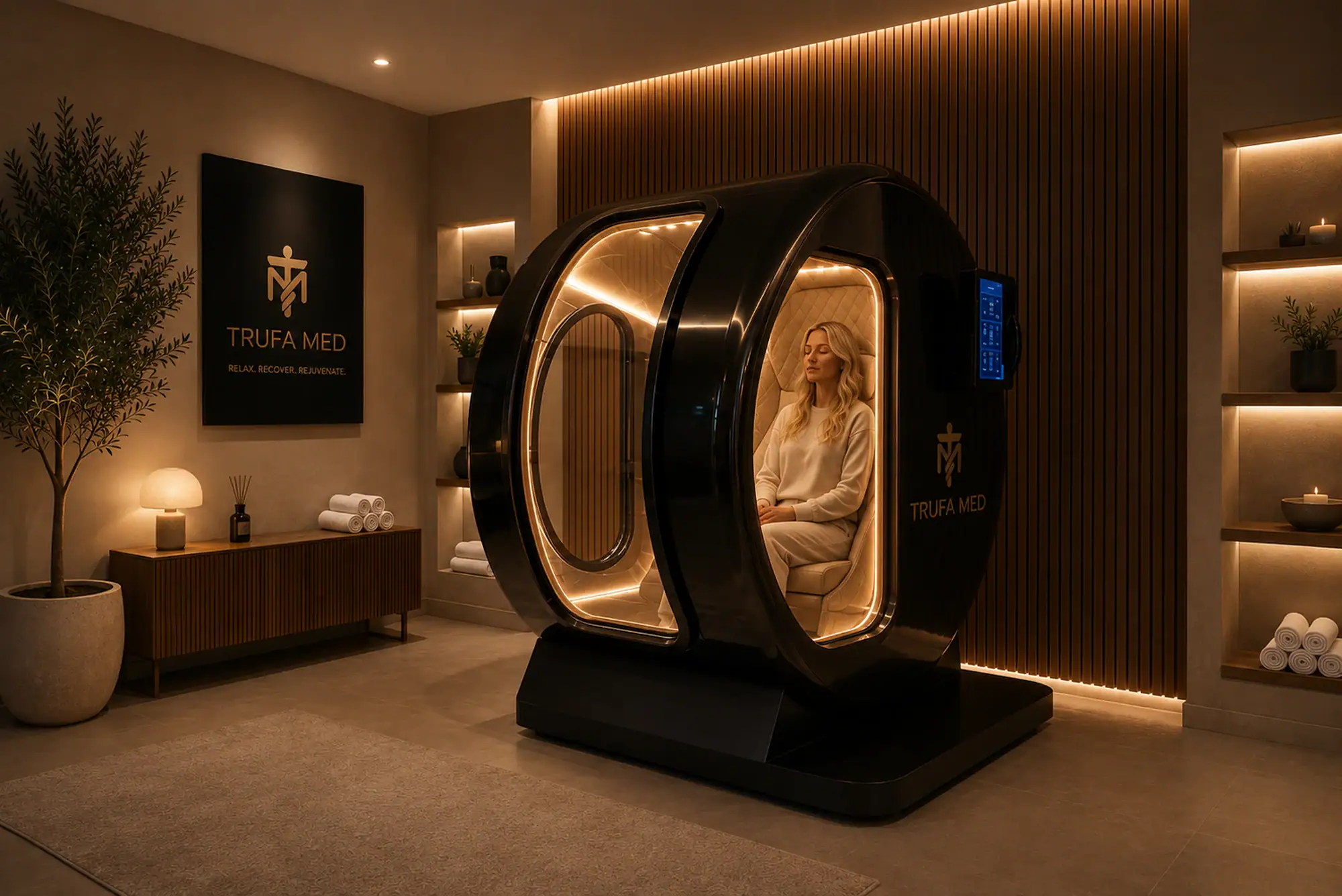
HBOT Recovery
for Athletes
Recover faster between training and competition. A physician-supervised soft-shell chamber, 100% medical-grade oxygen, and a board-certified physician on every session at Florida’s only Joint Commission-accredited urgent care.
A supportive recovery tool with a developing evidence base. WADA-permitted. Physician clearance comes first.
 Joint Commission Accredited
The only one in Florida
What does HBOT do for athletes?
Hyperbaric oxygen therapy, or HBOT, is a physician-supervised treatment in which you breathe 100% medical-grade oxygen inside a pressurized chamber. The added pressure dissolves far more oxygen into your blood plasma than breathing room air can, and that oxygen reaches muscle and connective tissue beyond what blood flow alone delivers. For athletes, the goal is recovery: calmer inflammation, support for tissue repair, and the chance to train again sooner. It is a supportive tool with a developing evidence base, used by professional and amateur athletes. It does not replace training, rest, and rehab.
At TrufaMED in Surfside, minutes from Miami Beach, athletic HBOT is delivered under physician supervision at our Joint Commission-accredited clinic, not an unsupervised gym or wellness-center setting. Every athlete is examined and cleared by a physician first, and a physician is present for every session, in the same Joint Commission-accredited facility that houses our on-site digital X-ray, labs, and IV recovery drips.
How oxygen under pressure supports recovery
Recovery is a physiological process, and HBOT works on the parts of it that depend on oxygen. These are the pathways the therapy is studied to support, explored under physician guidance. No fixed outcome is promised.
Muscle tissue oxygenation
Under pressure, oxygen dissolves directly into your blood plasma and saturates working muscle, including tissue that is inflamed or low on blood flow after a hard session. More available oxygen is what the repair process runs on.
Lactate and metabolic clearance
Better tissue oxygenation supports the aerobic pathways that clear the metabolic byproducts of intense training, which is part of why many athletes feel less heavy and stiff after a session.
Inflammation modulation
Hyperbaric oxygen helps quiet the inflammatory cascade that drives swelling and soreness. The aim is to shorten the painful peak of recovery, not to erase the inflammation your body needs to adapt and get stronger.
Collagen and soft-tissue repair
Oxygen is required for collagen synthesis, the building block of tendon and ligament repair. For slow-healing, low-blood-supply tissue, added oxygen is studied to support the remodeling phase alongside rehab.
New blood vessels
Sustained high oxygen levels signal the body to build new capillary networks, a process called neovascularization. Better local circulation carries recovery forward long after a session ends.
Neuroprotection
Greater oxygen perfusion supports the brain’s neuroprotective pathways, one reason HBOT is studied for concussion. For contact-sport athletes, see our concussion recovery page.
HBOT is a supportive recovery tool with a developing evidence base. It complements training, nutrition, sleep, and rehab. It does not replace them.
Recovery built around your sport
Different sports stress the body differently, so protocols are not one-size-fits-all. Your physician sets pressure, session length, and frequency around your training load and competition calendar.
Endurance athletes
Triathlon, marathon, open-water, and cycling. Recovery support between long training blocks and a careful pre-race taper, planned so a session sits in the right window before your event.
Strength and power
CrossFit, powerlifting, Olympic lifting, and football. Support for the soreness and soft-tissue load of heavy, high-volume training, with sessions timed to the days after your hardest work.
Combat sports
MMA, boxing, Brazilian jiu-jitsu, and Muay Thai. Recovery from the repeated impact and soft-tissue strain of contact training, with neuroprotection a relevant consideration discussed with your physician.
Masters and weekend athletes
Masters swimming, tennis, golf, and the committed weekend athlete. Recovery support to train consistently and bounce back from the nagging strains that come with age and load.
Pair HBOT with IV recovery drips
HBOT delivers oxygen. An IV delivers hydration, electrolytes, and nutrients directly to the bloodstream. Many athletes do both in one visit, and every in-clinic IV includes complimentary red light therapy.
Superstar IV
Our most complete recovery infusion, built for athletes who want the fullest support after a hard block or competition.
Rehydrate+ IV
Fast, focused hydration and electrolytes to rebound from heavy sweat loss, heat, and endurance training in the Miami sun.
NAD+ IV
A cellular-energy infusion some athletes use for recovery and focus. Your physician advises whether it fits your goals.
Every in-clinic IV session includes complimentary red light therapy. Explore the full IV therapy menu, or ask about IV and HBOT memberships for athletes who train year-round.
How a recovery session works
What to expect at the Surfside suite, starting with the exam that clears you for therapy.
Exam and clearance
Your first visit includes a physical exam and an on-site chest X-ray. Your physician reviews your training, injury history, and goals and confirms HBOT is safe and appropriate for you.
Settle into the chamber
Wear loose cotton clothing and leave electronics and jewelry outside. Avoid alcohol beforehand and arrive with a light meal. You lie comfortably and can rest or close your eyes.
Pressure and pure oxygen
The chamber pressurizes to 1.6 ATA while you breathe 100% medical-grade oxygen. You may feel mild ear fullness that clears the way it does on a plane. A physician is present throughout.
Recover and reload
A session runs 60 to 90 minutes. Hydrate well afterward, consider pairing with an IV drip, and ease off high-intensity training for a couple of hours so the recovery response can finish.
Why a clinical chamber matters for recovery
HBOT for athletes is offered casually around Miami, often by gyms and spas with no physician and soft portable chambers that cannot reach therapeutic pressure. The chamber and the oversight are what make it clinical.
TrufaMED clinical HBOT
- Physician-supervised soft-shell chamber
- 1.6 ATA on 100% oxygen (hard-shell 3.0 ATA arriving late August 2026)
- 100% medical-grade oxygen to the athlete
- Physician exam and clearance before therapy
- A physician present for every session at an accredited facility
Unsupervised spa or gym units
- No physician evaluation or supervision
- Much lower pressure, near sea-level air
- Slightly enriched air, well below 100% oxygen
- Often no medical screening
- Typically unsupervised, with no clinical oversight
Simple rates, no commitment
Transparent pricing with no hidden fees. Your first visit covers the medical clearance you need before therapy. The package is built for a structured recovery course.
The required intake before any recovery protocol. Your physician confirms HBOT is right for you, then you begin the same day if cleared.
Book first sessionThe core athletic recovery course, flexible across a training block. The most cost-effective way to complete a full protocol.
Reserve the packageFor athletes who want to drop in around heavy weeks, travel, or competition, with no monthly commitment required.
Book a follow-upConcierge members receive member-rate pricing and priority scheduling on HBOT. See our concierge memberships or the full HBOT cost guide.
Safe, supervised, and permitted in sport
Two questions athletes ask most: is it safe, and will it affect my eligibility. Here are the honest answers, with the contraindications that the required exam exists to catch.
HBOT is permitted in competitive sport. The World Anti-Doping Agency does not prohibit it and never has, because it is an oxygen environment rather than a drug and produces no detectable substance. Athletes competing under WADA, USADA, NCAA, or professional programs can use it freely, and we provide documentation of your sessions if your governing body asks.
On safety, the most common experience is mild ear pressure during pressurization, which clears like it does on a plane. A few conditions can rule out therapy or require treatment first, including an untreated collapsed lung, certain lung diseases, and active sinus or ear congestion. Some medications and recent treatments also need review. This is exactly why a physical exam with an on-site chest X-ray comes before your first session, built into the $300 first visit, so your physician can confirm HBOT is right for you before anything begins.
The physicians on every session
Your recovery protocol is designed and supervised by Dr. Uri Gedalia, Chief Medical Officer, and Dr. Shane D. Naidoo, Medical Director, whose combined experience spans emergency medicine, trauma, critical care, general surgery, and wound care.
Dr. Naidoo brings extensive adult and pediatric emergency, trauma, and critical-care experience from high-volume emergency departments across the East Coast. Emergency physicians read injuries quickly and decisively, the judgment you want screening and supervising an athletic recovery protocol.
Dr. Gedalia earned his medical degree from Louisiana State University and completed his surgical residency at St. Vincent’s Hospital in New York. He serves as Regional Chief Medical Officer for a surgical and wound-care program, experience that shapes how TrufaMED designs HBOT protocols for soft-tissue and injury recovery.
A board-certified physician is present for every session. That is why TrufaMED carries Joint Commission accreditation, held by only eight urgent care centers in the United States, the same standard applied to major hospitals.
What athletes ask first
The questions athletes across Miami, Miami Beach, Bal Harbour, and Surfside ask before their first recovery session.
Does HBOT help athletic recovery?
It can, and it is best understood as a supportive recovery tool with a developing evidence base. Results are not guaranteed. By dissolving extra oxygen into your blood plasma, HBOT delivers oxygen to muscle and connective tissue beyond what blood flow alone can carry. That is studied to help calm inflammation, support tissue repair, and may shorten the duration of soreness so you train again sooner. Many professional and amateur athletes use it for exactly these reasons. Your physician sets realistic expectations for your goals during your evaluation.
How soon after an injury or hard session should I start HBOT?
For soft-tissue injuries such as muscle strains, ligament sprains, and contusions, earlier tends to help more, often within 24 to 48 hours, when reducing swelling and inflammation matters most. For delayed-onset muscle soreness, a session within a few hours of a heavy training block is a common approach. For fractures, wait for physician clearance once the bone is set and stable. Your specific timing is set with our physician team.
How close to a competition can I do HBOT?
For experienced HBOT users, a shorter session at a lower pressure up to about 48 hours before race day is generally well tolerated and useful. If you are new to the therapy or have any ear or sinus sensitivity, avoid a session within 48 hours of competing, and skip the day before entirely for a first visit. We help you plan the timing around your event.
Is HBOT allowed in competitive sport, and does it show on a drug test?
Yes, it is fully permitted. The World Anti-Doping Agency does not prohibit hyperbaric oxygen therapy and never has. It is an oxygen environment and produces no detectable substance. Athletes competing under WADA, USADA, NCAA, or professional drug-testing programs can use HBOT without risk to eligibility. We can provide documentation of your sessions if your governing body requests it.
How often should an athlete use HBOT?
For general performance maintenance, one to two sessions per week is sustainable. During a heavy training block or after a major competition, three to five sessions in the following week offers the most recovery support. For an acute injury, a common acute-phase approach is daily sessions for the first five to seven days, then every other day. Your frequency is determined with our physician team.
Does HBOT really help delayed-onset muscle soreness (DOMS)?
It can help, with nuance. HBOT does not eliminate DOMS, and some post-exercise inflammation is necessary for adaptation. What it may do is shorten the duration and reduce the peak of soreness, particularly when used within a few hours of the training that caused it. Athletes who use it after a hard session often report that next-day soreness is present but does not limit training.
Can HBOT help tendon injuries like Achilles or patellar tendinopathy?
It can serve as a supportive adjunct. Tendons are slow to heal precisely because they receive limited blood supply. The plasma-dissolved oxygen that HBOT delivers reaches tissue that circulation struggles to supply, which is studied to support the collagen-remodeling phase of recovery. HBOT does not replace physical therapy. It is used alongside rehab under physician guidance.
What are the risks or side effects?
The most common experience is mild ear pressure during pressurization, similar to descending in an airplane, which clears by swallowing, yawning, or the Valsalva maneuver. A small number of patients in longer multi-week courses notice mild, temporary changes in distance vision that resolve after treatment ends. Serious effects are rare at the 1.6 ATA used in our soft-shell protocols. Our physicians screen for risk factors before your first session.
How is this different from a spa or gym hyperbaric chamber?
Significantly. Unsupervised spas and gyms often run chambers without a physician present or any medical evaluation. TrufaMED uses a medical-grade soft-shell chamber at 1.6 ATA with 100% medical-grade oxygen, with a physician present for every session at a Joint Commission-accredited facility. A hard-shell chamber reaching 3.0 ATA arrives in late August 2026. The amount of oxygen that actually reaches your tissue is far greater in a clinical chamber.
Do I have to commit to a membership or package?
No commitment is required. Single sessions are available through same-day online booking, which suits athletes with unpredictable training and travel schedules. Multi-session packages are offered at preferred pricing for those who want a structured recovery course. Concierge members receive member-rate pricing plus priority scheduling, useful for guaranteed same-day access during heavy training or competition season.
Recovering from something more than training?
HBOT supports a range of recovery goals beyond sport. Explore a dedicated page, or read how the therapy works in our benefits guide.
What patients say
Best clinic ever
Excellent. Attentive clean
The staff is very nice and courteous
Very nice receptionist
Best place I’ve been to by far great service
The staff are amazing, from front desk, registration, nurse , the Dr. A mean the facility very clean, conftuble, I'll give them 150% plus on everything and all. Thank you so very much
Care grounded in recognized authorities
TrufaMED is a Joint Commission accredited clinic, and our hyperbaric protocols reference peer-reviewed evidence and federal guidance. These independent sources are offered for further reading.
Complete your recovery stack
Recovery and wellness
IV Therapy Miami IV & HBOT Memberships Performance Medicine Post-Surgery Recovery Concierge MedicineFind us in Surfside
Hours
Monday–Friday 9 AM – 9 PM
Saturday 11 AM – 11 PM
Sunday 12 PM – 8 PM
HBOT sessions are by appointment. Same-day booking is often available.
Contact
Phone (305) 537-6396
WhatsApp +1 (305) 842-9801
Email [email protected]
For a life-threatening emergency, call 911. TrufaMED treats non-life-threatening conditions.
Book your recovery session
Clinical-grade hyperbaric oxygen for athletic recovery, delivered the right way, with a physician on every session at an accredited facility.
Notes from your physicians, every other week.
Seasonal health for South Florida, what we are seeing at the clinic, and the occasional thing worth knowing. No spam, and you can leave anytime.
TrufaMED, in your pocket.
Book urgent care, IV therapy, HBOT and telehealth, track your wellness, and reach your care team, all from the app.