
Services
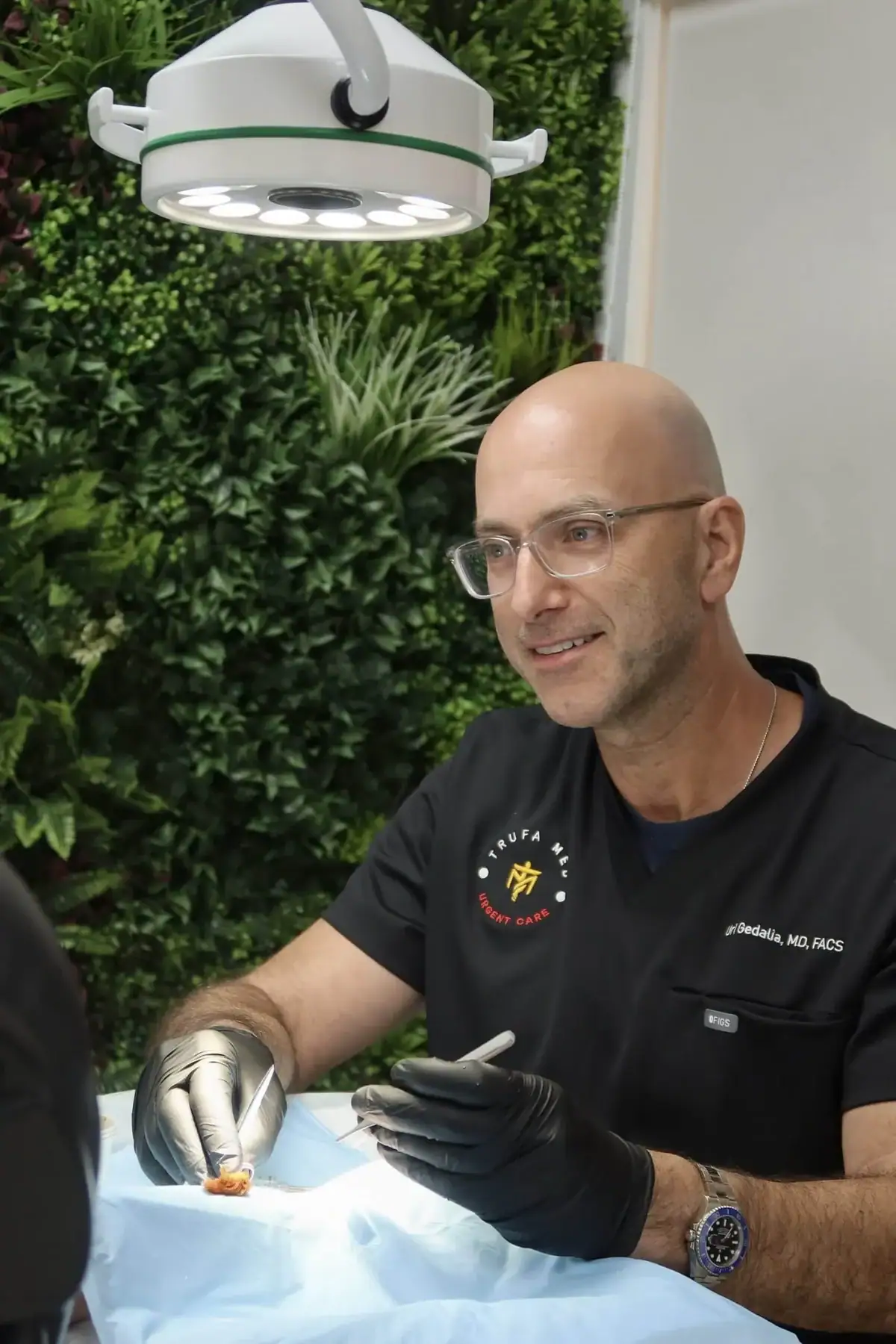
Wound Care
Treatment
Walk in for sterile irrigation, infected wounds, abscess drainage, burns, and tetanus, all in one physician-led visit. Same-day, no appointment, for a fraction of the ER cost.
 Joint Commission Accredited
The only one in Florida
Can I walk in for wound care today?
Yes. TrufaMED treats acute wounds (abrasions, punctures, bites, burns, infected wounds, and abscesses) on a walk-in basis seven days a week, under physician supervision. A typical wound visit, from exam and irrigation through tetanus, dressing, and discharge, takes about 45 to 90 minutes. Wound healing depends on the first hour more than most patients realize, and at TrufaMED every wound is seen and managed by a board-certified physician.
The full non-surgical wound spectrum
Most acute wounds are urgent-care level, and each type has its own evaluation and treatment path. We manage them in clinic with on-site irrigation, dressings, tetanus, antibiotics, and imaging when needed.
Abrasions and road rash
Scooter, bike, and skate scrapes are the most common wounds we see. They need thorough irrigation to remove embedded grit, which otherwise tattoos into the healing skin, plus a non-adherent dressing and a tetanus update if due.
Puncture wounds
Nails, fish hooks, glass, sharp shells, and construction debris. Punctures are deceptive: the visible damage is small but the deep tissue has not been cleaned. Irrigation, a foreign-body search, and tetanus are essential.
Animal and human bites
Dog, cat, and human bites carry a high infection rate, especially on the hand. Most get preventive antibiotics, a rabies-risk assessment, and a tetanus update. Severe bites to the hands or face may warrant surgical review.
Infected wounds
Redness, warmth, spreading streaks, pus, pain out of proportion, or fever. We drain abscesses, culture when indicated, choose the right oral or IV antibiotic, and set a clear follow-up window before you leave.
Pressure sores
Bed sores on the heels, sacrum, and elbows in patients with limited mobility. We stage, clean, and dress them, and, just as important, identify and help correct the source of pressure causing the wound.
Chronic non-healing wounds
Diabetic foot ulcers, venous and arterial leg ulcers, and any wound open longer than four weeks. These need a systematic plan: infection control, circulation review, diabetes management, and often HBOT.
For a fresh cut that needs closing, see our laceration and stitches care. For a possible broken bone, see sprains and fractures.
Evaluation, irrigation, and debridement
Every acute wound visit follows the same sequence. The details shift by wound type, but the framework is consistent. Skipping steps, especially irrigation, is the single most common reason a wound goes on to get infected.
Focused history and exam
When, how, and where. A bite carries a different risk than an identical cut from a rusty nail. We ask about the mechanism, the time since injury, the contamination source, your immunization history, and conditions like diabetes.
Foreign-body search
Many punctures hide a retained piece of glass, wood, or metal. A missed foreign body is a leading reason wounds fail to heal. We use bedside exam, magnification, and on-site digital X-ray or ultrasound to find and remove it.
Sterile irrigation
The single most important step. We flush the wound with sterile saline at enough pressure to dislodge bacteria and debris. Good irrigation lowers infection rates more than any single antibiotic decision, and contaminated wounds get more of it.
Debridement
Devitalized tissue feeds bacteria. We trim away non-viable skin edges and necrotic tissue under local anesthesia when needed. This is conservative, in-clinic sharp debridement; extensive cases are referred to surgery.
Closure decision
Not every wound should be sutured. Clean, sharp, recent wounds may be closed; heavily contaminated, bite, or older wounds often heal better left open or closed later. Forcing the wrong closure turns a small wound into an abscess.
Dressing and home plan
A moist wound bed heals about twice as fast as a dry one. We dress the wound to fit its depth, drainage, and location, and you leave with a written plan for changing it at home and a follow-up window.
When a wound turns: cellulitis and abscess
Skin and soft-tissue infections are among the most common reasons patients come to urgent care for a wound. Knowing the difference between spreading redness and a drainable pocket of pus decides the treatment.
Cellulitis without an abscess
Spreading redness, warmth, swelling, and tenderness with no drainable pocket. We mark the borders to track it and treat with oral antibiotics. Fever, rapid spread, or hand and face involvement may need IV antibiotics or emergency care.
Abscess drainage
An abscess is a pocket of pus, and the treatment is drainage. Antibiotics alone will not clear it. We numb the area, make a small incision over the most raised point, drain the cavity, break up pockets, and irrigate, then dress and schedule a recheck.
Antibiotics after drainage
Most simple abscesses in healthy adults need no antibiotics once drained. We add them when surrounding cellulitis is extensive, when you have diabetes or a weakened immune system, or when the abscess sits on the face, hand, or another high-risk site.
Knowing when to escalate
Pain out of proportion to the exam, a crackling feel under the skin, discoloration spreading past the redness, or feeling systemically unwell can signal a rare but dangerous deep infection. We recognize these early and arrange direct emergency transfer.
Redness that spreads, streaks toward the trunk, or comes with fever is a same-day concern. Walk in, do not wait it out at home.
Tetanus and antibiotics, the simple rules
Two questions come up at almost every wound visit: do I need a tetanus shot, and do I need antibiotics? The honest answer is usually clearer than patients expect, and we make both calls with you.
The tetanus shorthand is a five-year rule for dirty wounds and a ten-year rule for clean ones. If your most recent Tdap was more than five years ago and your wound is dirty, deep, a bite, or a puncture, you need a booster. If it was more than ten years ago, you need one for any wound, even a minor scrape. We keep Tdap in stock and give it at the visit, so there is no second trip. Antibiotics are a separate decision, and most clean, well-irrigated wounds simply do not need them.
When antibiotics help
- Animal and human bites, especially cat and human bites on the hand
- Punctures through a shoe, where deeper germs are a concern
- Wounds in patients with diabetes or a weakened immune system
- Wounds with visible tendon, bone, or joint
- Wounds already infected with spreading redness or fever
- Saltwater or brackish-water injuries that need special coverage
When they are not needed
- Clean, well-irrigated cuts closed soon after the injury
- Scrapes and abrasions without infection in a healthy patient
- Superficial cuts and paper cuts
- Most simple abscesses once they are drained
- Wounds where thorough irrigation has done the real work
Minor burns, treated. Serious burns, transferred.
Most burns we see are small first- and second-degree burns from cooking, hot liquids, and beach or pool equipment. We evaluate size and depth, dress them properly, and identify the burns that belong in a specialized burn center.
What we treat in clinic
First-degree burns and small superficial second-degree burns in non-critical locations. We cool the burn, clean it gently, drain large tense blisters under sterile conditions, apply a topical antimicrobial, and dress it.
Reading the depth
Red and painful with no blister is first-degree. Blistered, wet, and painful is superficial second-degree. Drier, pale, and oddly less painful suggests a deeper burn. The depth drives the plan more than the size.
When a burn center is needed
Deep second- or third-degree burns, burns to the face, hands, feet, genitals, or major joints, burns that circle a limb, and electrical, chemical, or inhalation injuries. We make that call early and arrange direct transfer.
Chemical and eye burns
Chemical burns are flushed with copious irrigation first, then evaluated. A chemical splash to the eye is an emergency: rinse and go to the nearest emergency room without delay.
We also update tetanus and provide pain relief for burns, with a follow-up in 24 to 48 hours for anything beyond a superficial first-degree burn.
A wound open four weeks needs a different plan
Urgent care alone will not close a chronic wound. When a wound has failed to heal in four weeks, the systemic drivers (diabetes, circulation, pressure, infection, and nutrition) have to be addressed in parallel. For oxygen-starved wounds, hyperbaric oxygen therapy can be the difference between healing and amputation.
The most common chronic wounds we see in Miami are diabetic foot ulcers, venous ulcers on the lower leg, arterial ulcers in patients with poor circulation, and pressure sores. Each needs its own workup: diabetes and HbA1c control, a circulation assessment, an X-ray to rule out bone involvement, an offloading plan to take pressure off the wound, attention to nutrition, and referral to a wound center, podiatry, or vascular surgery when indicated. We start that workup the same day you walk in.
For the right wounds (deeper diabetic foot ulcers, failed grafts and flaps, chronic bone infection, and radiation tissue damage), hyperbaric oxygen therapy can dramatically speed healing. HBOT delivers high concentrations of oxygen under pressure, driving it into tissue that is otherwise oxygen-starved. It stimulates new blood-vessel growth, improves the immune response, and fights certain bacteria directly. TrufaMED offers HBOT on-site in Surfside, so a chronic wound does not have to mean a separate wound-center referral. Candidacy is determined by a physician after the workup, and most major plans and Medicare cover HBOT for approved wound indications.
When a wound needs the emergency room
Urgent care handles the overwhelming majority of wound visits. A small set need the resources of an emergency department: operating rooms, blood banks, and surgical specialists. The findings below move care from urgent care to the ER.
Bleeding that will not stop
Bleeding that continues despite 15 minutes of firm pressure, or bright red blood that spurts with the pulse, suggests an artery injury. Call 911 or go to the nearest emergency room.
Nerve or tendon injury
Numbness past the wound, or an inability to move a finger or toe normally, can mean a severed nerve or tendon. That needs an emergency or specialist repair.
Deep or dangerous wounds
Wounds to the chest, abdomen, back, or neck, an eye injury, an amputation or degloving, or any major trauma from a crash, fall, or assault belong in the emergency room.
Severe burns and deep infection
Third-degree burns, large second-degree burns, electrical or inhalation injury, and signs of a spreading deep infection are emergencies. We identify these on arrival and arrange transfer.
If you are unsure, come in. We triage on arrival, and when the exam warrants emergency-level care we arrange a direct transfer without a second evaluation. For a true emergency, call 911.
Why choose TrufaMED for wound care
Wound care in urgent care ranges from excellent to careless. What you want is sterile technique, on-site imaging, physician judgment, and the medications to treat what walks through the door. Wound closure is core to our Chief Medical Officer’s surgical training.
Florida’s only accredited urgent care
Joint Commission accreditation audits our sterile technique, medication safety, and infection control, the same body that accredits hospitals. We are the only accredited urgent care in Florida, one of just eight nationwide.
Led by a board-certified surgeon
Every wound is managed by a board-certified physician. Our Chief Medical Officer, Dr. Uri Gedalia, is a general surgeon who also serves as Regional Chief Medical Officer for a surgical and wound-care program.
On-site X-ray and ultrasound
Retained foreign body? A fracture under a wound? Digital X-ray and bedside ultrasound are available in the same visit, with no separate imaging appointment to schedule.
Tetanus, antibiotics, and drainage in clinic
Tdap in stock, oral and IV antibiotics on hand, local anesthesia and abscess drainage routine, and an on-site lab for wound cultures when they are needed.
HBOT on-site for chronic wounds
For chronic non-healing wounds that meet criteria, on-site hyperbaric oxygen therapy avoids a separate wound-center referral and keeps your care under one roof.
Most insurance accepted
Wound care is covered by most major plans, including Aetna, Cigna, UnitedHealthcare, Humana, Oscar Health (urgent care), and Medicare. Self-pay is quoted up front, with no surprise billing.
Clear pricing, no surprise bills
We accept most major insurance plans and bill your visit to your carrier. No insurance? A physician visit starts at $195, and any procedure, such as abscess drainage or wound closure, is quoted up front based on the wound, before any work begins.
Procedures are priced at your visit based on the wound. Starting prices shown; final cost depends on the care you need. See the full sheet on our self-pay pricing page, or review accepted plans on our insurance page.
A surgeon and an emergency physician
Wound care is where clinical training shows. TrufaMED is led by Dr. Uri Gedalia, Chief Medical Officer, and Dr. Shane D. Naidoo, Medical Director, with five physicians on staff whose experience spans general surgery, wound care, and emergency medicine, with a surgeon directing the wound-care program.
Dr. Gedalia earned his medical degree from Louisiana State University and completed his surgical residency at St. Vincent’s Hospital in New York. As a board-certified general surgeon, wound care is central to his training. He also serves as Regional Chief Medical Officer for a surgical and wound-care program, so a complex, infected, or non-healing wound is in expert hands.
Dr. Naidoo brings extensive adult and pediatric emergency, trauma, and critical-care experience from high-volume emergency departments across the East Coast. He has treated wounds of every kind under pressure, from contaminated abrasions to deep infections, and brings calm, decisive judgment to assessing and managing each one safely.
Wound care questions, answered
The questions our physicians answer most often about walk-in wound care across Surfside, Miami Beach, and Bal Harbour.
Can I walk in for wound care without an appointment?
Yes. TrufaMED treats acute wounds on a walk-in basis seven days a week under physician supervision, no appointment needed. You can also check in online ahead of time to reduce your wait. Our hours are Monday to Friday 9 AM to 9 PM, Saturday 11 AM to 11 PM, and Sunday 12 PM to 8 PM. A typical wound visit, from exam and irrigation through tetanus, dressing, and discharge, runs about 45 to 90 minutes.
My wound is red and warm. Is it infected?
Some redness in the first day or two is normal healing. The signs that point to infection are different: redness that spreads beyond the wound edges, increasing warmth, a red streak running toward the trunk, a new pocket of swelling or pus, fever, or pain that is getting worse instead of better. Any of those deserves a same-day evaluation. Do not wait. Early infection treated with oral antibiotics usually clears quickly, while advanced infection can need IV antibiotics or drainage.
Do I need a tetanus shot for this wound?
It depends on what the wound looks like and how long since your last Tdap. For a clean, minor wound, a booster within the last 10 years is enough. For a dirty, deep, puncture, or bite wound, the cutoff shortens to 5 years. If you are not sure when your last shot was, we can often pull the record or simply give a booster at the visit. We keep Tdap in stock, so there is no second trip.
Will I need antibiotics?
Often the right answer is no. Most clean, well-irrigated wounds do not need oral antibiotics, and thorough irrigation prevents infection better than a prescription in nearly every study. Antibiotics matter for a specific set of wounds: animal and human bites, punctures through a shoe, wounds in patients with diabetes or a weakened immune system, wounds with visible tendon or bone, and wounds that are already infected. Your physician prescribes when the evidence supports it and skips when it does not.
Can you drain an abscess in urgent care?
Yes. Incision and drainage of a skin abscess is a routine urgent care procedure. We numb the area with local anesthesia, make a small incision over the point where the pocket is most raised, drain the pus, break up any internal pockets, irrigate, and pack the wound when needed. For most simple abscesses in otherwise healthy adults, the drainage itself is the treatment and antibiotics are not required. We schedule a wound check in 24 to 48 hours before you leave.
My diabetic foot has a sore that will not heal. What should I do?
Come in promptly. A non-healing diabetic foot ulcer needs a systematic workup: infection screening, an X-ray to look for bone involvement, a review of your diabetes control, a circulation assessment, an offloading plan to take pressure off the wound, and a referral to a specialist when indicated. For deeper ulcers that meet criteria, on-site hyperbaric oxygen therapy may be appropriate. Acting early on a diabetic foot wound is the single best way to prevent it from progressing to an amputation.
Should this wound be stitched or left open?
It depends on the wound. Clean, sharp, recent cuts, generally under 12 hours old and up to 24 hours on the face, usually close well with sutures, skin glue, or staples. Heavily contaminated wounds, bites, and older wounds often heal better left open with good wound care, or closed a few days later once they are clean. Forcing a closure on the wrong wound is a common cause of trapped infection. Your physician makes that call based on what the wound looks like. For a fresh cut that needs closing, see our laceration and stitches care.
What about a wound from a beach or ocean injury?
Saltwater and brackish water exposures are special cases. Organisms such as Vibrio and Aeromonas are uncommon in everyday wounds and need specific antibiotic coverage, typically doxycycline combined with ciprofloxacin. Stingray, jellyfish, and sea urchin injuries each have their own management. Given our location in Surfside, our physicians treat these routinely, so a cut or sting from the water is worth having looked at the same day.
How long does a wound care visit take?
Most wound visits run about 45 to 90 minutes. Simple abrasions and minor wounds are often closer to 30 to 45 minutes. Wounds that need imaging, extensive irrigation, layered closure, or abscess drainage usually run 60 to 90 minutes. Chronic wound evaluations can take longer because of the more detailed history and workup involved.
Does insurance cover wound care visits?
Yes, for most major plans. Wound evaluation, irrigation, tetanus, suturing, abscess drainage, imaging, and antibiotics are standard urgent care services covered by Aetna, Cigna, UnitedHealthcare, Humana, Oscar Health (urgent care), and Medicare. We verify your benefits at check-in and explain any out-of-pocket cost before treatment. Self-pay patients are always welcome, with a physician visit starting at $195 and any procedure quoted up front, so there are no surprise bills.
Other injuries we treat same-day
A wound often arrives with a cut that needs closing, a possible broken bone, or a need for imaging. We handle the full range of non-emergency injuries in one visit.
What patients say
Best clinic ever
Excellent. Attentive clean
The staff is very nice and courteous
Very nice receptionist
Best place I’ve been to by far great service
The staff are amazing, from front desk, registration, nurse , the Dr. A mean the facility very clean, conftuble, I'll give them 150% plus on everything and all. Thank you so very much
Care grounded in recognized authorities
Diagnosis and treatment follow guidance from national health authorities and accreditation standards.
Find the right care
Injuries & wounds
Wound Care Lacerations & Stitches Sprains & Fractures HBOT for Wound Healing Digital X-RayWalk in for wound care in Surfside
Hours
Monday–Friday 9 AM – 9 PM
Saturday 11 AM – 11 PM
Sunday 12 PM – 8 PM
Walk in anytime during open hours, no appointment needed.
Contact
Phone (305) 537-6396
WhatsApp +1 (305) 842-9801
Email [email protected]
For a life-threatening emergency, call 911. TrufaMED is an urgent care clinic and does not provide emergency room care.
Injured? Walk in.
Wound evaluation, sterile irrigation, tetanus, antibiotics, and dressings in a single urgent care visit at 9445 Harding Ave. A board-certified physician, on-site imaging, open seven days a week. No appointment needed.
New here? Start with our guide to burn and wound first aid, and when to come in.
Notes from your physicians, every other week.
Seasonal health for South Florida, what we are seeing at the clinic, and the occasional thing worth knowing. No spam, and you can leave anytime.
TrufaMED, in your pocket.
Book urgent care, IV therapy, HBOT and telehealth, track your wellness, and reach your care team, all from the app.